
Channel i Online English
Sunday, July 26, 2026
বাংলা
  • Home
  • Politics
  • World
  • Crime
  • Bangladesh
  • Sports
  • Entertainment
  • Science
  • Technology
  • Opinion
  • Lifestyle
  • Education
  • Others
No Result
View All Result
Channel i Online English
বাংলা
Home World

How US policy is unintentionally forging a China-Russia-India nexus

ChannelionlinebyChannelionline
September 1, 2025
in World
Reading Time: 2 mins read
A A
Advertisements

The U.S. decision to impose steep tariffs on Indian exports has triggered one of the most consequential shifts in Eurasian geopolitics in recent years.

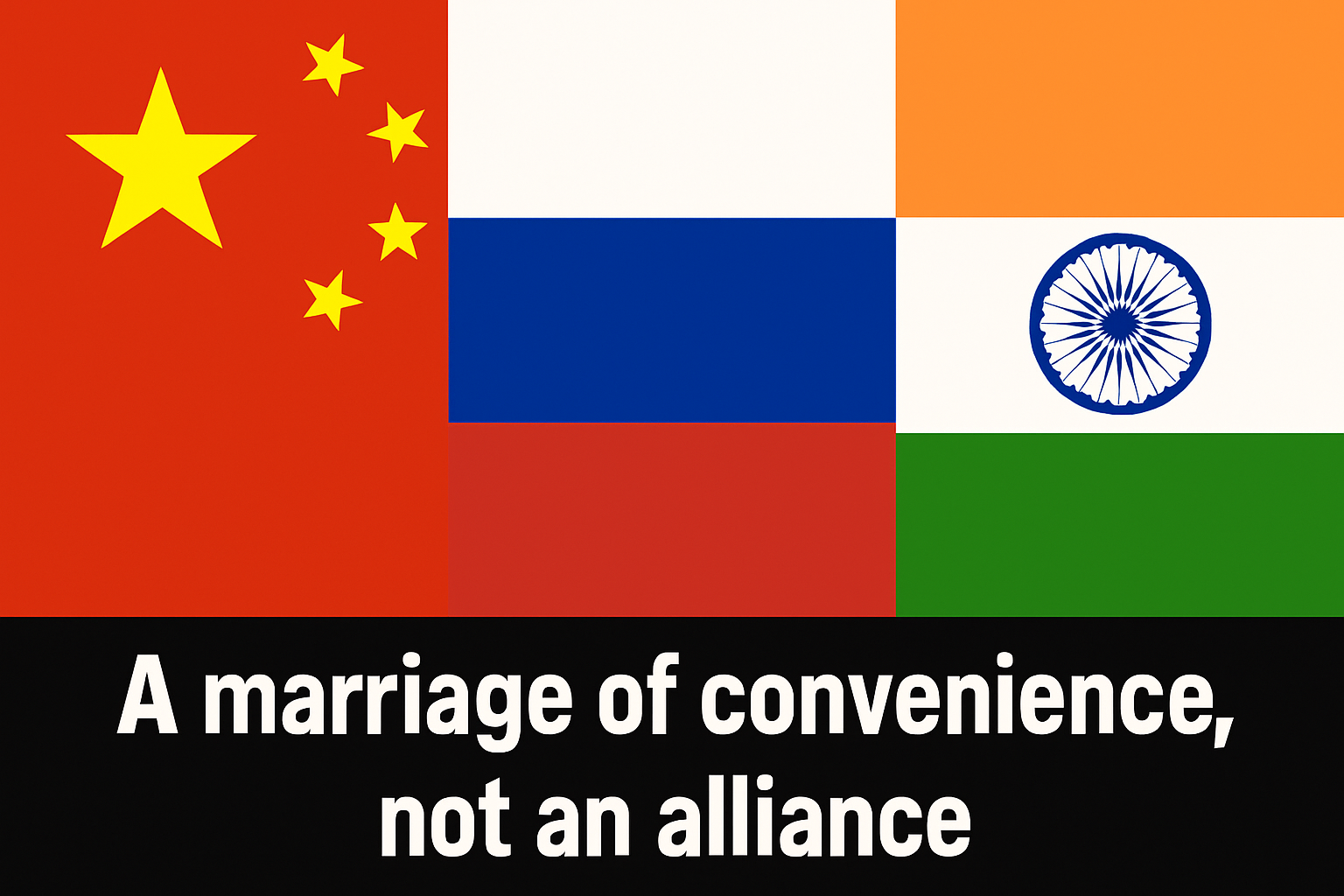
Rather than coercing India into distancing itself from Moscow, Washington’s economic offensive has nudged New Delhi closer to both Russia and China, reviving a once-dormant trilateral axis.

The spectacle at the Shanghai Cooperation Organisation (SCO) summit in Tianjin, where Narendra Modi, Vladimir Putin, and Xi Jinping publicly embraced, symbolised this recalibration.

India’s pivot is not rooted in ideology but in necessity.

Facing a 50% tariff wall that directly harms its labor-intensive industries, New Delhi is hedging by reopening diplomatic channels with Beijing and deepening energy ties with Moscow. Russia, weakened by sanctions, eagerly seeks partners, while China views India’s drift as an opportunity to showcase U.S. unreliability and advance a multipolar world order.

Together, the three represent one-third of global output, vast reserves, and nearly 40% of the world’s population, an alignment too significant to dismiss, even if fragile.

Yet this is far from a seamless alliance.

India and China remain divided by their Himalayan border, memories of the deadly 2020 Galwan clash, and Beijing’s partnership with Pakistan. India’s economy is still heavily tied to Western markets, with U.S. trade and technology access far outweighing anything Russia or China can provide. Moreover, Russia’s growing dependence on Beijing undermines its traditional role as a neutral broker between its two Asian partners, complicating the triangle.

For Washington, the tariffs have become a strategic own-goal. While intended to punish India for buying Russian oil, they have instead weakened years of U.S. effort to integrate India into the Indo-Pacific security architecture. Allies like Japan and Australia, themselves wary of American protectionism, are recalibrating as well, raising doubts about the Quad’s effectiveness.

Critics within the U.S. warn that these moves are shredding Washington’s credibility, branding America as unreliable at the very moment China pushes an alternative vision of order.

The Tianjin summit thus marks more than symbolic handshakes– it reflects a deeper shift toward strategic autonomy across Eurasia.

The China-Russia-India convergence may not evolve into a formal alliance, but it highlights the costs of coercive U.S. policy and signals a geopolitical environment where multipolarity is accelerating. Whether Washington adjusts course or entrenches this trajectory will shape the balance of power for years to come.


Share this:

  • Share on Facebook (Opens in new window) Facebook
  • Share on X (Opens in new window) X
  • Share on WhatsApp (Opens in new window) WhatsApp
Tags: ChinaindiaJinpingModiPutinQUADRussiasemi lead
Previous Post

BAU students block rail line to press three-point demand

Next Post

Hasan Saimum Wahab earns PhD from University Putra Malaysia

Related Posts

A New equation for soybeans: Oil, protein and the cost of damage

A New equation for soybeans: Oil, protein and the cost of damage

January 13, 2026
The Strategic Soul of the Arctic Why Greenland is Vital to U.S. National Interests

The strategic soul of the Arctic: Why Greenland is vital to U.S. national interests?

January 11, 2026
Next Post

Hasan Saimum Wahab earns PhD from University Putra Malaysia

Please login to join discussion

Latest

Drowning in data, starved for stories
Education

Drowning in data, starved for stories

July 18, 2026

There is a profound irony in the architecture of the modern internet. Never before in human history has the sum...

Read moreDetails
Sunali Khatun: The Woman the Indian Constitution Failed to Protect

Sunali Khatun: The Woman the Indian Constitution Failed to Protect

July 11, 2026
High-quality feed key to future growth of global aquaculture

High-quality feed key to future growth of global aquaculture

July 11, 2026
Hasan Ishtiaque to Showcase Bangladeshi Dance Excellence in Taiwan

Hasan Ishtiaque to Showcase Bangladeshi Dance Excellence in Taiwan

June 26, 2026
Scott Wang visits WTC Dhaka to strengthen trade, investment links

Scott Wang visits WTC Dhaka to strengthen trade, investment links

June 15, 2026

Publisher: Shykh Seraj

Impress Telefilm Limited, 40, Shaheed Tajudding Ahmed Sarani, Tejgaon Industrial Area, Dhaka-1208, Bangladesh

www.channeli.com.bd,
www.channelionline.com 

Phone: +88028891161-65
info@channelionline.com
online@channeli.tv (Online)
news@channeli.tv (TV)

Categories

  • Agriculture
  • Bangladesh
  • Climate and Weather
  • Corporate
  • Crime
  • Education
  • Entertainment
  • Enviornment
  • EURO 2024
  • Health
  • India
  • International
  • Lifestyle
  • Opinion
  • Others
  • Politics
  • Politics
  • Science
  • Special
  • Sports
  • Tariff on India by US
  • Technology
  • USA
  • World
No Result
View All Result
  • Home
  • Politics
  • Crime
  • World
  • Bangladesh
  • Sports
  • Entertainment
  • Science
  • Technology
  • Opinion
  • Education
  • Lifestyle
  • Others

© 2025 Channel i - Customize news & magazine theme by Channel i IT

Exit mobile version