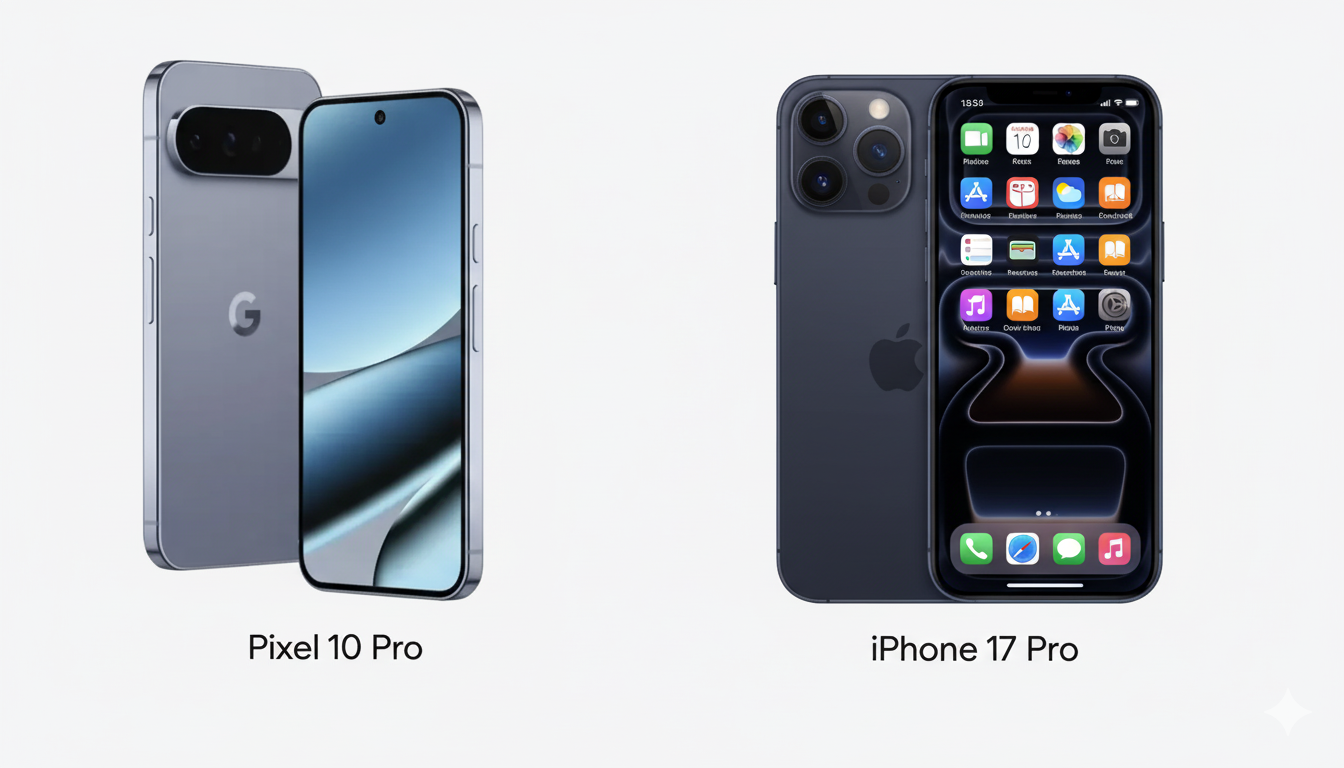
The annual battle for smartphone supremacy has reached its zenith with the official launch of Apple’s iPhone 17 Pro and Google’s Pixel 10 Pro. This year, the competition is more than just an incremental update; it’s a fundamental clash of philosophies. Apple refines its powerful, ecosystem-centric formula, while Google pushes the boundaries of artificial intelligence and hardware customization. For consumers, the choice has never been more compelling—or more difficult.
Display and Design: A Feast for the Eyes
Both flagships are stunning to behold. The iPhone 17 Pro features its signature Super Retina XDR display with ProMotion, housed in a durable aluminum unibody. It also introduces a new Action button and dedicated Camera Control for faster access to creative tools.
Google’s Pixel 10 Pro, however, makes a bold statement with its Super Actua LTPO display, which can reach a dazzling peak brightness of 3300 nits, making it exceptionally viewable in direct sunlight. Protected by Corning® Gorilla® Glass Victus® 2, the Pixel is built for both beauty and resilience.
The Power Within: A19 Pro vs. Tensor G5
At the heart of the iPhone 17 Pro lies the new A19 Pro chip, a powerhouse designed for top-tier performance and efficiency, complete with hardware-accelerated ray tracing for next-level gaming. Apple promises an impressive “up to 39 hours of video playback,” a testament to its hardware and software integration.
Google counters with its custom-built Tensor G5 processor, co-designed with a Titan M2 security coprocessor. The Tensor G5 is engineered specifically for Google’s advanced AI and machine learning tasks. Paired with a massive 16 GB of RAM, the Pixel 10 Pro is a multitasking beast, built to handle the sophisticated AI features that define its user experience.
The Camera Clash: Computational Prowess vs. Fusion Power
Photography is the main event in this rivalry. Apple’s Pro Fusion camera system arms the iPhone 17 Pro with three distinct 48MP lenses (Main, Ultra Wide, and Telephoto), enabling super-high-resolution photos and next-generation portraits. A standout feature is its ability to shoot in Dolby Vision up to 4K at an incredible 120 fps.
The Pixel 10 Pro responds with a formidable triple-camera setup of its own: a 50MP wide lens, a 48MP ultrawide lens with Macro Focus, and a 48MP telephoto lens with 5x optical zoom. Where Google truly flexes its muscles is in software and zoom capabilities, offering Pro Res Zoom up to 100x and the ability to record in stunning 8K resolution. Its suite of AI-powered editing tools, like Magic Eraser and Pixel Studio, remains a key advantage for creative control.
AI and Software: Intelligence vs. Gemini
The software experience defines these two devices. The iPhone 17 Pro is powered by Apple Intelligence, deeply integrated into the OS for a seamless and intuitive user experience.
The Pixel 10 Pro, meanwhile, is a showcase for Google’s AI, with Gemini built-in as an AI assistant. Features like Circle to Search, Live Translate, and AI-powered call assistance are at the forefront. Crucially, Google solidifies its value proposition by promising an unprecedented seven years of OS, security, and feature updates, setting a new standard for smartphone longevity.
Choosing between these two titans depends entirely on your priorities.
The iPhone 17 Pro is the champion of refined power and seamless integration. It’s for the user who values a polished ecosystem, incredible video capabilities, and the raw performance of Apple’s A-series chips.
The Pixel 10 Pro is the innovator’s choice. It’s for the user who wants the most advanced AI features, unparalleled camera flexibility with its powerful zoom and editing tools, and the security of a seven-year update commitment.
This year, more than ever, there is no single winner. Instead, consumers are presented with two exceptional, albeit different, visions for the future of mobile technology.