
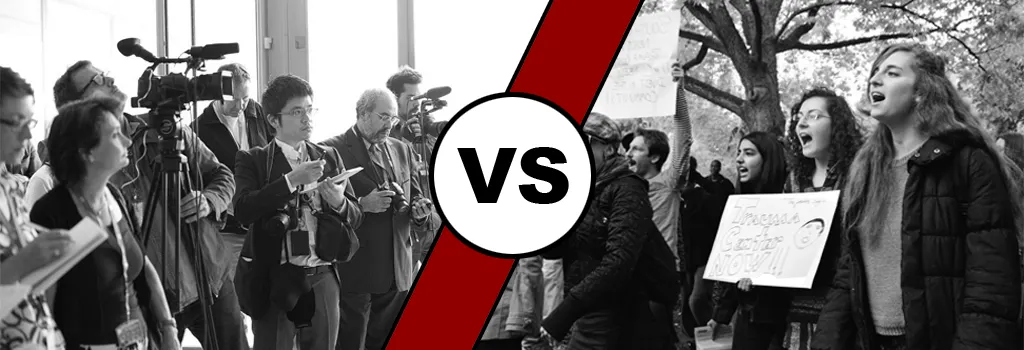
In 2020, as the world erupted in protest at the murder of George Floyd, the Black Lives Matter movement surged with renewed force. In the midst of that historic moment, journalists working for Report for America received a stark directive from their director, Alison Bethel McKenzie: “you cannot wear a Black Lives Matter T-shirt out in the field. Nor can you donate to one of the social media fundraisers for the cause.” As Thompson reported at the time, the decision sent ripples of frustration through newsrooms, exposing the uneasy fault line between personal conviction and professional duty.
Less than a year later, the Associated Press dismissed Emily Wilder after just three weeks in her post. Tweets written during her student years, in support of Palestinian rights, resurfaced and sealed her fate, as Nashrulla documented in 2021. These are not isolated incidents. They reflect a deeper and unresolved question that cuts to the heart of modern journalism: can, or indeed should, reporters also be activists?
For decades, the conventional answer has been no. The Code of Ethics issued by the Radio, Television, and Digital News Foundation warns that “political activity and active advocacy on issues” can erode both actual and perceived independence. Readers and viewers are less inclined to trust the impartiality of a journalist who openly campaigns for a cause. In 2017, journalist Deepak Adhikari argued that in an age of “clickbait, misinformation and alternative facts”, the need for balanced, evidence-based reporting has never been greater.
This caution is not simply about individuals. As McBride observed in 2021, activism by one journalist can reverberate across entire organisations, influencing colleagues and undermining credibility. For this reason, outlets such as The Washington Post impose strict policies, directing their journalists to steer clear of partisan political activity, community activism or social action. Their guidelines are blunt:
Journalists should not participate in or advocate for causes such as politics, community, or social action. These include, but are not limited to, political parties, candidates, groups, rallies, issues and political movements; or community organisations or actions that promote or address specific causes.
Not everyone accepts such prohibitions. Laura Wagner, writing for Defector and cited by Kafka in 2021, argued that journalism should abandon the “unreasonable and hideously stupid expectation that reporters must harbour no strong opinions about the things they care about.” Journalists, after all, are also citizens. To demand they erase their personal convictions—even outside the newsroom—is, critics say, to curtail fundamental freedoms.
That view has been echoed by researchers. At the Center for Media Engagement, Kat Williams, Kerry O’Malley Gleim and Scott R. Stroud have explored whether the public regards journalists’ activism as compatible with professional responsibility. Their work reveals a nuanced picture: perceptions vary by context, by the nature of the activism, and by the degree of transparency involved.
The broader critique is equally pointed. In 2015, a BuzzFeed News editorial argued that “objectivity is better weaponised by those who are committed to maintaining unjust power structures.” For some issues—civil rights, women’s rights, anti-racism, and LGBT equality—there are not two sides, as Hilton noted that year. The journalist and academic Kiva Hanson has reminded us that activism is not new to journalism, pointing to Ida B. Wells, co-founder of the National Association for the Advancement of Coloured People (NAACP). Wells’s meticulous reporting exposed the brutality of lynching in the United States, demonstrating how journalism has historically played an activist role in confronting injustice.
Some organisations, meanwhile, have sought compromise. Axios permitted its journalists to attend Black Lives Matter protests, recognising their rights as citizens under the First Amendment. Yet co-founder Jim VandeHei warned staff that partisanship could corrode trust, close doors to sources and jeopardise their work, as Lee and Smith reported in 2020. His memo, he stressed, was no call to march but a reminder of the risks.
McKenzie, too, speaks from experience. Having faced racism herself, she urges Report for America journalists to weigh their decisions carefully. With millions of citizens marching online and in the streets, she reminds her staff that the number of journalists of colour covering such movements remains woefully small. In her view, as Thompson reported in 2020, retaining credibility and access may deliver greater long-term impact than sacrificing careers for a symbolic stand.
The struggle between conscience and profession is unlikely to fade. Journalists will continue to grapple with questions of neutrality, freedom, and justice. Some may seek independence to speak without constraint; others will remain within institutions, working to reshape norms from the inside. Either way, the debate forces the industry to revisit, and perhaps rewrite, the principles that underpin public trust.
The Center for Media Engagement, itself, embodies this reflection. Based at the Moody College of Communication at The University of Texas at Austin, the Centre brings together faculty, staff, post-doctoral, graduate and undergraduate researchers, alongside partner academics across the United States and beyond. Officially founded in 2017, it traces its origins to 2011 as the Engaging News Project at the Annette Strauss Institute for Civic Life. Its history mirrors the broader struggle within journalism: how media can both reflect society and respond to its urgent calls for change.