In a press release on Friday, July 26, BCSNA stated, “We, several Bangladeshi citizens united through the social media forum Bangladeshi Communication Scholars in North America, are deeply concerned about the recent government crackdown on student protestors and the onslaught of totalitarian oppressive measures in Bangladesh.”
“We hereby demonstrate our solidarity with the student community of Bangladesh, who have been rightfully protesting to reform the discriminatory quota system in government jobs and are now demanding justice for the deaths of unarmed civilians and ongoing legal harassment.”
“We extend our support to the demands of the general students of Bangladesh, not just with their calls for restructuring an unfair quota system but also the emerging demands for broader political reforms and holding the perpetrators of the killings accountable. While the Supreme Court of the country has ruled in favor of the student protestors’ demands, which still have to be implemented by the government in the months to come, the decision came too late. In mid-July, these young individuals were peacefully advocating for fair opportunities in government employment.”
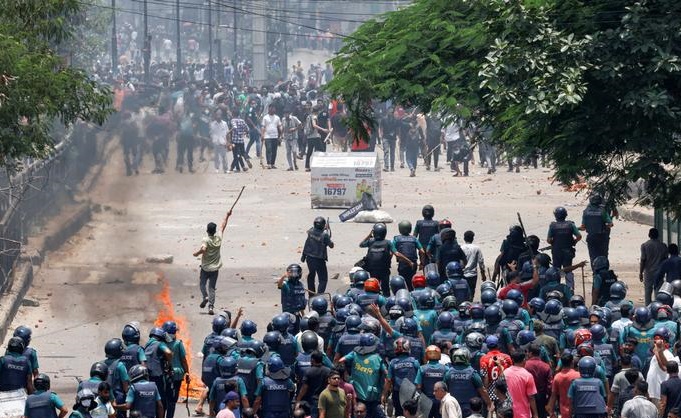
“The government first showed disrespect towards the protestors and their cause, then deployed every force at their disposal, often firing at unarmed protestors from close proximity. According to a BBC report, ‘The protesters were hurling bricks and stones at police who responded with shotgun fire, tear-gas, and sound grenades, while a helicopter was firing from the air’ (BBC, July 24, 2024).”
“To date, nearly 200 unarmed student protestors have tragically lost their lives at the hands of police and ruling party-affiliated organizations. There are also unreported deaths and thousands with serious injuries, making this plight even more tragic and unacceptable (AFP, July 23, 2024; Associated Press, July 18, 2024; CBS, July 23, 2024; BBC, July 22, 2024; Al Jazeera, July 23, 2024).”
“Subsequently, on July 19, the government imposed a nationwide curfew, deploying the army with a shoot-on-sight order for any protester, restricting media and telecom operations, and shutting down the internet, leading to a total information and communication blackout and cutting off Bangladesh from the rest of the world (The Diplomat, July 21, 2024; The Guardian, July 23, 2024).”
“Such desperate measures further worsened the suffering and exacerbated fears and uncertainties both among the people within the country and within diasporic communities like ours, who couldn’t contact their families at home. As limited communication and mobility are now possible (as of July 24), horrific witness accounts of the carnage are unfolding, and it will continue to mire the future of democracy and political participation in the country.”
“So far, instead of accepting responsibility and firing the executives in power, the government, in its usual fashion, has denied any wrongdoing and blamed the opposition political parties and even social media for the mayhem. This is deplorable.”
“In retrospect, the tradition of student organizing and movements is longstanding in the history of Bangladesh. Due to the sacrifices made by student protestors in 1952, Bangla was recognized as an official language of the state. Student protestors played important roles in subsequent national movements, which eventually culminated in the 1971 war for liberation, resulting in the free nation of the People’s Republic of Bangladesh.”
“Even after liberation, student protests have time and again raised important questions against systemic oppression in Bangladesh. Examples of the Protests for Road Safety and the No VAT on Education Movement are well documented.”
“It is the legacy of these justice movements and their orientation towards equality and democracy that is upheld by the current protests for quota reform. In contrast, the ruling party has turned itself into an autocratic regime through three consecutive questionable elections and allegedly other coercive mechanisms, including torture, extrajudicial killings, and forced disappearances. Consequently, the student protest now has turned into a broader movement against autocratic oppression, corruption, and social injustices. We support it wholeheartedly.”
“As community members of BCSNA, we strongly believe in the ethos of fairness, equity, justice, and equal opportunity, and therefore express deep concern for the safety and well-being of the students protesting for these values of a just and equitable Bangladeshi society. We heavily criticize and denounce the Bangladeshi government and its administration for the mishandling of the student protest that resulted in the death of innocent civilians.”
“We implore international communities against authoritarian oppression to utilize all available avenues to pressure the Bangladeshi government to cease these egregious acts of violence immediately. Furthermore, we urge you to hold the executive body of the government accountable under international legal standards and humanitarian law for these atrocities and crimes against humanity.”
“We stand in unity with the protesting students and the general public of Bangladesh and demand justice for each and every student protester who has been killed by order of the government and call for the resignation of the responsible culprits in power.”