

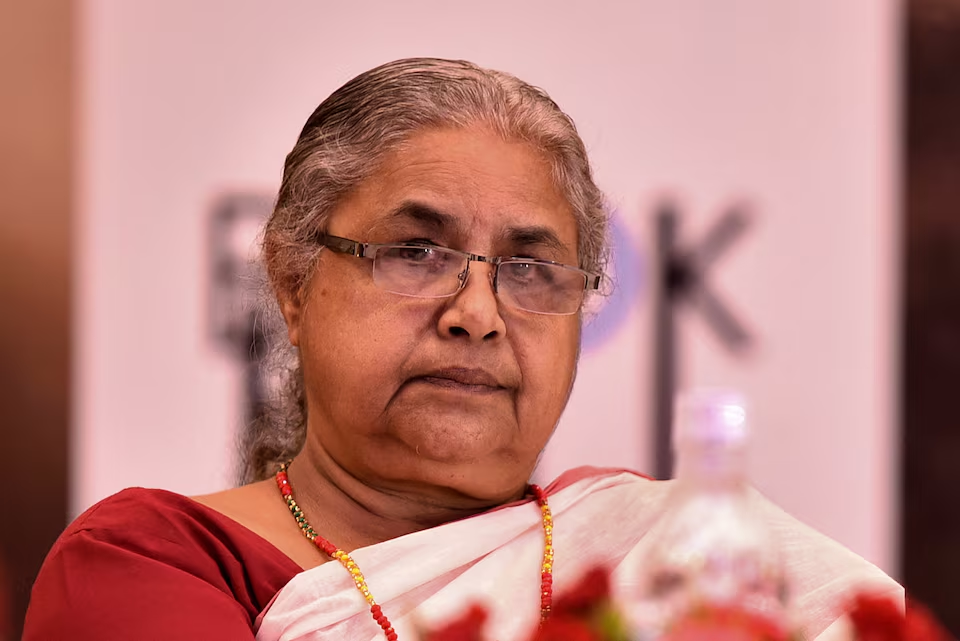
Kathmandu begins a new and unpredictable era as Sushila Karki, the nation’s first woman chief justice, was sworn in on Friday evening as interim prime minister.
The appointment comes after days of tumultuous protests which saw the resignation of KP Sharma Oli. The agreement was reportedly brokered between President Ramchandra Paudel, the leaders of Nepal’s Generation Z protest movement and the Nepal Army chief, General Ashok Raj Sigdel.
The Judge who left the Bench for politics
Ms Karki is not a natural politician. Her credentials come from her 12-month tenure as chief justice of the Supreme Court between 2016 and 2017, when she won plaudits for taking a tough stance on corruption.
That judicial legacy — and her reputation for independence — saw her thrust into the political limelight during the mass protests calling for clean governance. Her meteoric rise has been compared with that of Nobel Peace Prize laureate Muhammad Yunus, who was last year asked to head Bangladesh’s interim government following a student-led revolt.
Born in the east, educated in India
Ms Karki was born in 1952 into a farming family in eastern Nepal. She was the eldest of seven siblings. Her family had close ties with Bishweshwar Prasad Koirala, Nepal’s first democratically elected prime minister.
She graduated from Mahendra Morang Campus in 1972, completed a master’s in political science at the Banaras Hindu University in India in 1975, before going back to Nepal to complete a law degree at Tribhuvan University in Kathmandu.
She began her working life as a teacher, later moving into legal practice in Biratnagar.
Accelerated judicial career, failed impeachment
Her judicial career began with her appointment as a temporary Supreme Court judge in 2009. She was appointed a permanent judge a year later, before being elevated to chief justice in July 2016.
In April 2017, lawmakers attempted to impeach her over a ruling which disqualified the head of the National Vigilance Commission, Nepal’s anti-corruption watchdog.
The motion led to her suspension, but triggered public outrage and was later withdrawn.
Among her other landmark judgments was the sentencing of Information and Communications Minister Jaya Prakash Prasad Gupta for corruption.
Indian connection through marriage
It was during her stint at Banaras Hindu University that she met her future husband, Durga Prasad Subedi, then a youth leader of the Nepali Congress.
Mr Subedi was a key player in one of Nepal’s most dramatic episodes — the hijacking in 1973 of a domestic Nepal Airlines flight carrying 4m Nepalese rupees in state funds.
The hijackers forced the plane to land in Bihar, India, where the money was handed over to Girija Prasad Koirala, a four-time prime minister later.
The money was reportedly used to buy arms for the Nepali Congress’s fight against the monarchy. Mr Subedi spent two years in an Indian jail before returning to Nepal.
The protest movement that shifted the political landscape
The unrest that led to Ms Karki’s appointment was fuelled by anger at corruption and censorship.
At least 51 people have been killed and more than 1,300 injured this week after security forces opened fire on protesters defying curfews. The protests were sparked by the Oli government’s imposition of — and subsequent revocation of — a nationwide ban on social media.
Shops reopened in the Kathmandu Valley on Friday as soldiers were withdrawn from the streets. Police, who have been given batons but not rifles, remain on duty at key intersections.


