Since the dawn of human civilization, clothing has not only served the purpose of covering the body but also functioned as a medium for expressing personal identity, status, and social standing. Over time, the form and significance of clothing have evolved, but one idea has consistently remained present in society, that is the concept of the “dress code” or prescribed clothing norms.
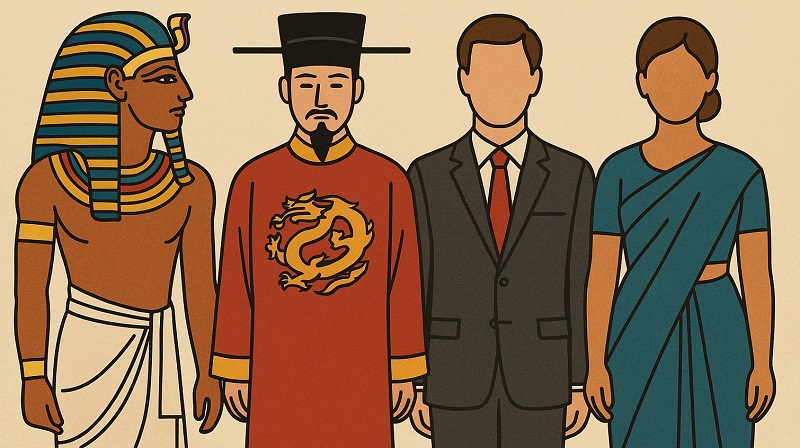
In ancient Egypt, the types of clothing worn by royal family members were forbidden for ordinary people. Similarly, during China’s Qing dynasty, the “dragon robe” was exclusively reserved for the emperor. In medieval Europe, laws were enacted to regulate clothing types, assigning specific garments to different social classes. Sometimes, these rules were enforced through religious customs as well.
In modern times, the idea of a dress code took a more structured form in professional settings. In various institutions, attire became a symbol of discipline, respect, and professionalism. In banks, courts, schools, and the military, uniforms or specific dress styles became an integral part of institutional order.
However, since the late 20th century, questions began to arise about dress codes in the context of personal freedom, gender equality, religious identity, and cultural diversity. In many cases, strict dress codes have been seen to conflict with individual liberties.
In Bangladesh, the concept of a dress code is not entirely new. Both public and private institutions informally follow a ‘professional look’. Modesty and neatness in dress are especially emphasized in banks, educational institutions, and the judiciary. A recent directive by Bangladesh Bank, however, brought this practice to the center of public debate.
The directive contained specific guidelines about employee attire, which many perceived as one-sided and culturally biased. Some even termed it an interference with personal freedom and a violation of constitutional rights. The issue sparked widespread discussion and criticism on social media. In response, Bangladesh Bank quickly withdrew the directive.
This incident goes beyond a single administrative order and raises a broader question: can an adult citizen not choose their own clothing? Can an institution maintain professional decorum while also avoiding cultural or religious bias?
Supporters argue that dress codes help ensure discipline and uphold a professional image in the workplace. On the other hand, critics say they often clash with personal freedom, especially when they reflect a bias toward specific cultural or religious norms. In modern society, guidelines may be acceptable, but a mandatory “code” can infringe on individual rights, according to human rights activists.
The debate over dress codes is unlikely to end anytime soon. But right activists say, now is the time to rethink the question: is a dress code merely a symbol of order, or is it a subtle tool of control? They assert that the recent controversy involving Bangladesh Bank reminds that balancing personal freedom with social discipline is the foundation of a just and egalitarian society.