
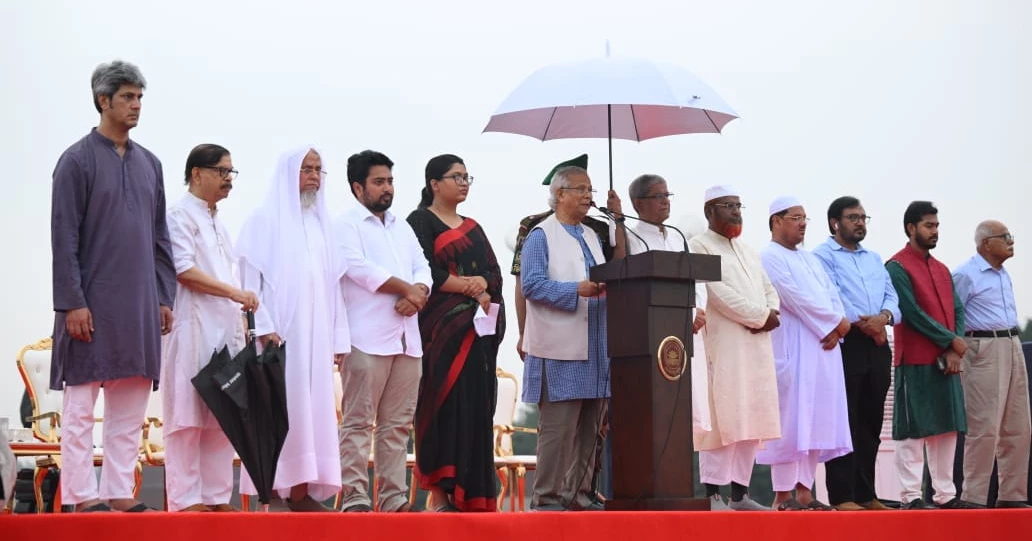
The “July Declaration” read out by Chief Adviser Muhammad Yunus on the first anniversary of the July Uprising is both retrospective and prospective: it seeks to delegitimise the preceding era, codify the uprising as a historical rupture, and lay out a blueprint for democratic reconstitution and justice.
The first 21 points of the 28-point declaration serve as background, while the remaining seven outline commitments, pledges, and aspirations.
Its opening clauses frame the uprising as part of a historical continuum beginning with the anti-colonial struggle against Pakistan and culminating in the Liberation War of 1971.
By asserting that the aspirations for democracy, equality, and social justice proclaimed in the Declaration of Independence were betrayed early in the post-independence period, the document ties the events of 2024 directly to earlier unfinished struggles for popular sovereignty.
The declaration also invokes the memory of the November 7, 1975 uprising and the 1990 anti-autocracy movement, portraying the uprising not as an isolated revolt but as the latest in a recurring national cycle of resistance to authoritarian rule and reassertion of democratic ideals.
The declaration then turns sharply toward an extensive denunciation of Sheikh Hasina’s 16-year tenure, portraying it as the culmination of Bangladesh’s democratic backsliding that ensued from 1/11.
It accuses her regime of dismantling constitutional safeguards, centralising power, staging sham elections, and weaponising state institutions to entrench a “fascist” one-party system.

Specific grievances include enforced disappearances, suppression of dissent, abductions, and systemic corruption alongside economic mismanagement and environmentally harmful policies disguised as development.
The declaration highlights social discontent over the quota-based job system and partisan recruitment, emphasising how resentment among students and job seekers combined with political repression to generate broad-based anger. This section positions Hasina’s rule as the central antagonist in the narrative, presenting her removal as both an inevitable and necessary corrective.
In recounting the events of 2024, the declaration elevates the anti-discrimination student movement as the spark that ignited the mass uprising. It credits students with mobilising society across political, social, and professional lines into a unified force that challenged Hasina’s grip on power.
The inclusion of details about brutal state violence, mass killings, and widespread participation across social strata underscores the scale of resistance and its cost.
The reference to the armed forces’ support at the uprising’s final stage is significant, as it portrays military intervention not as a coup but as an alignment with popular will, reinforcing the narrative of a people’s revolution. The culmination of these events in Hasina’s resignation and flight is presented as the decisive moment of democratic restoration.
Following this, the declaration justifies the subsequent institutional transition, describing the dissolution of the 12th National Parliament and the constitutional installation of Yunus’s interim government under Article 106 as a lawful response to a political and constitutional crisis.

By citing the Supreme Court’s endorsement, it merges the revolutionary legitimacy of the uprising with procedural legality, seeking to position the interim administration as both a product of mass mobilisation and constitutional continuity. This framing attempts to reconcile extraordinary upheaval with formal governance norms, thereby strengthening the interim government’s domestic and international legitimacy.
The document concludes with an ambitious reformist agenda that blends transitional justice with long-term institutional reconstruction.
It pledges to hold accountable those responsible for crimes committed during Hasina’s rule, including enforced disappearances, unlawful killings, and corruption, while promising recognition of July’s martyrs as national heroes and legal protections for participants in the uprising.
“… The people of Bangladesh express their desire that the student-people uprising of 2024 will get proper state and constitutional recognition and that the July declaration will feature in the schedule of the reformed constitution as framed by the government formed through the next national election,” said the declaration.
It outlines commitments to rebuild state institutions, ensure fair elections, strengthen the rule of law, and enshrine the uprising within a revised constitution, thus framing 2024 as a foundational moment akin to 1971.
It also situates future governance within a framework of human rights, anti-corruption measures, and sustainable, climate-resilient development, projecting a vision that links domestic renewal to international democratic and developmental norms.