


The first day of the final week of India’s Monsoon Session of Parliament began on August 5, 2024, like any other, with a packed legislative agenda and frenetic activity across New Delhi’s power corridors.
Yet, while the Treasury benches focused on pushing through pending bills, Prime Minister Narendra Modi’s closest aides– External Affairs Minister S. Jaishankar, National Security Adviser Ajit Doval, and Home Minister Amit Shah –were fixated on events unfolding in neighboring Bangladesh, BBC Bangla has reported.
That morning, Dhaka braced for mass protests under the “March to Dhaka” campaign, which aimed to blockade the capital. Indian intelligence briefings reassured New Delhi that despite facing her toughest political challenge yet, Bangladesh Prime Minister Sheikh Hasina would likely “survive” the crisis.
But by nightfall, in a stunning twist few anticipated, Hasina was on Indian soil seeking refuge.
Just a day earlier, on August 4, Modi and Hasina had spoken via hotline– with no hint of her imminent departure. Meanwhile, India’s newly appointed Army Chief General Upendra Dwivedi maintained constant contact with Bangladesh’s Army Chief General Waker-uz-Zaman, coordinating on the escalating unrest.
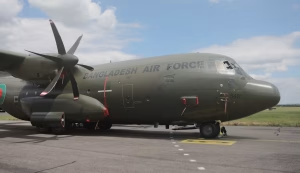
Despite clear signals of instability in Bangladesh, Delhi assumed the crisis would be contained. Indian officials never expected that by August 5, Hasina would flee Dhaka aboard a Bangladesh Air Force C-130 military aircraft, landing at Hindon Airbase near Delhi, according to BBC Bangla.
From midday, one extraordinary development followed another:
Hasina phoned Delhi herself, reportedly requesting temporary refuge.
Minutes later, Bangladesh’s Air Force sought clearance for her military aircraft to land in India.
By evening, Hasina, accompanied by her sister Sheikh Rehana, landed at Hindon, greeted by NSA Ajit Doval as Modi’s emissary.
This was no rescue mission, Indian officials stressed. “We didn’t extract her,” a source told BBC Bangla. “She arrived in a Bangladeshi aircraft– their own military brought her.”
As the unrest intensified, India discreetly evacuated embassy staff and families from Dhaka.
Meanwhile, anti-India sentiment surged, culminating in the vandalism and arson of the Indira Gandhi Cultural Centre in Dhaka, an escalation Delhi had not foreseen.
While Hasina’s departure set Delhi abuzz, Parliament carried on with routine business. Only late in the afternoon did Trinamool MP Sudip Bandyopadhyay raise concerns over “violence in neighboring Bangladesh,” only to be curtly told by the Speaker to “worry about your own country first.”
Behind closed doors, opposition leaders were briefed that Bangladesh’s situation was “fluid” and urged not to demand a government statement. An all-party meeting the following morning outlined India’s cautious approach.
According to BBC Bangla, Bangladesh’s military initially requested that India send a special aircraft to extract Hasina– a proposal Delhi rejected to avoid perceptions of “rescuing” her. Instead, Hasina flew on a Bangladesh Air Force plane, a move allowing India to insist she came on her own terms.

Initially, Indian officials believed Hasina’s stay would be “temporary” before heading to a third country. London was the presumed destination, given Hasina’s diplomatic passport and her sister Rehana’s UK dual citizenship. However, the new UK government under PM Keir Starmer blocked her entry, forcing India to host her longer than expected.
Since her arrival, NSA Ajit Doval has personally overseen Hasina’s security and arrangements, reminiscent of Congress leader Pranab Mukherjee’s role during Hasina’s exile in Delhi from 1975 to 1981 following her father Sheikh Mujibur Rahman’s assassination.
BBC Bangla notes that India has even conducted confidential “debriefing sessions” with Hasina, akin to protocols followed when high-profile political figures, such as the Dalai Lama, were granted refuge.
India continues to maintain that Hasina’s stay is “temporary.” Yet, her extended presence underlines the geopolitical shockwaves of Bangladesh’s crisis. As one senior official told BBC Bangla: “What happened on August 5 has rewritten the playbook for Delhi’s neighborhood policy– and it all began on that dramatic day when Hasina boarded that helicopter in Dhaka.”


