
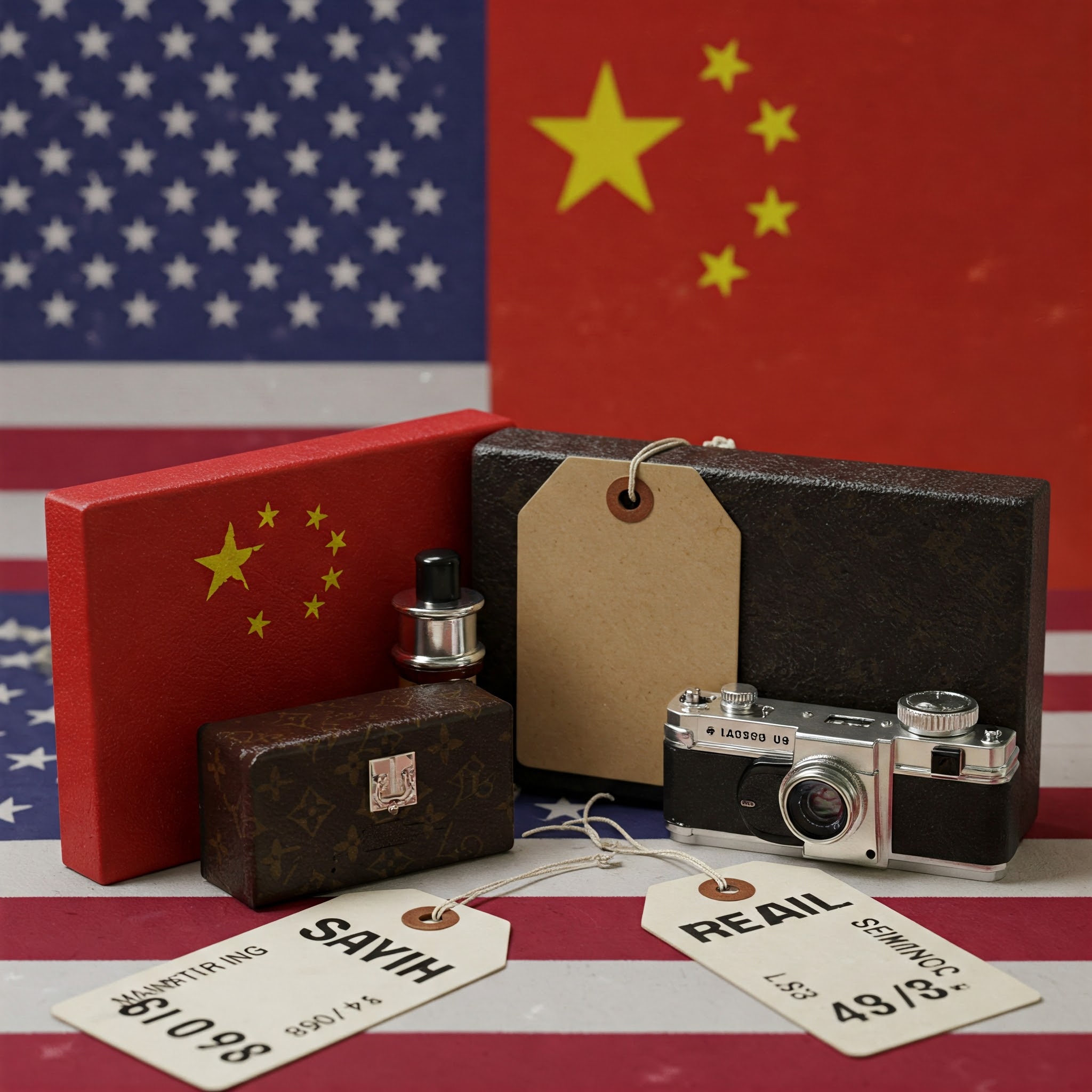
The escalating trade conflict between the United States and China, already marked by steep reciprocal tariffs, has entered a new and potentially more disruptive phase. Moving beyond traditional economic levers, China is now deploying a sophisticated strategy targeting the perceived value of Western luxury goods, leveraging its position as the world’s manufacturing hub to challenge the very foundation of brand equity.
Recent weeks have seen a dramatic rise in trade tensions, with the US imposing tariffs reportedly as high as 135% on certain Chinese imports, prompting swift retaliatory duties from Beijing reaching up to 145% on American products. However, analysts note that a simultaneous, less conventional offensive is underway, focused squarely on the high-margin luxury market.
China, the production site for a vast number of globally renowned luxury brands – including Louis Vuitton, Dior, Chanel, Hermès, Gucci, Prada, and components for tech giants like Apple and Sony – is now aggressively publicizing the often minuscule production costs behind these high-ticket items. This campaign appears strategically designed to expose the enormous gap between manufacturing expense and final retail price.
Information disseminating rapidly, particularly via social media platforms like TikTok, highlights stark examples:
- An Hermès Birkin bag, retailing for upwards of $25,000, is alleged to have a production cost of merely $180 in China.
- A pair of Dior high heels selling for $1,200 reportedly costs only $40 to manufacture.
- Gucci belts and T-shirts, priced at $700 and $400 respectively, are claimed to have factory costs of just $25 and $20.
- Even core modular components for Apple’s iPhone are cited as costing around $100 per set, a fraction of the $1,000-$1,500 retail price achieved after software installation and branding.
This informational offensive is coupled with a significant commercial element. Reports indicate the emergence of Chinese online marketplaces dedicated to selling “Original Equipment Manufacturer” (OEM) versions of these luxury products. These items allegedly boast the same materials and finish as their branded counterparts but lack the official logo, and are offered at prices dramatically closer to the revealed production costs. The implicit message: consumers are paying an exorbitant premium purely for the brand name, not for superior quality or craftsmanship.
Analysis: A Psychological Assault on Brand Value
This strategy represents a direct assault on the concept of brand equity, a cornerstone of Western consumer capitalism, particularly in the luxury sector. By framing luxury pricing as “branding manipulation,” China aims to:
- Disrupt Consumer Perception: Sow doubt among global consumers about the intrinsic value of luxury goods, potentially eroding brand loyalty and desirability.
- Undermine Western Economic Models: Challenge the high-margin business models that rely heavily on intangible brand value built over decades.
- Leverage Manufacturing Dominance: Turn its role as the “world’s factory” into a strategic advantage in the broader economic conflict.
This move constitutes a form of economic warfare that targets consumer psychology. It suggests that luxury is not inherently tied to quality but is instead a construct of marketing and perceived status. The potential impact could extend far beyond the balance sheets of individual companies, potentially reshaping consumer attitudes towards high-end goods globally.
While analysts agree that the United States remains the dominant global economic power, China’s willingness to employ such unconventional tactics underscores its determination to contest that position. This strategy highlights China as a formidable competitor capable of innovative, asymmetric approaches in the ongoing geo-economic rivalry.
The effectiveness of this campaign remains to be seen – brand loyalty, intellectual property rights, and consumer desire for authenticity are powerful counterforces. However, China’s explicit effort to deconstruct the value proposition of Western luxury marks a significant escalation and a potentially potent new dimension in the defining economic struggle of the 21st century. In this particular battle over perception and value, China appears to be making a calculated, aggressive push.