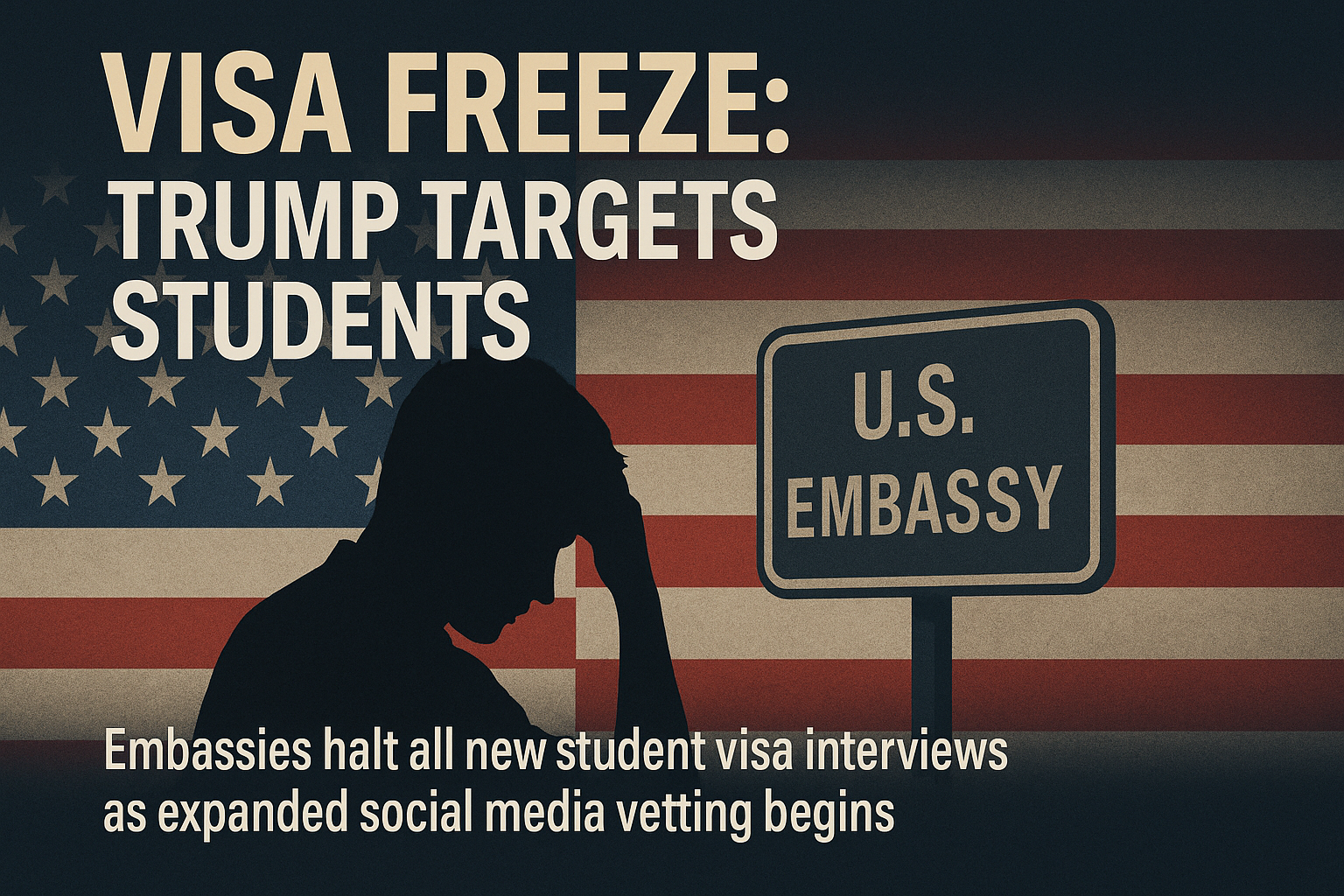
In a sweeping new directive that could upend the lives of thousands of international students and deal a major blow to U.S. higher education, the Trump administration has ordered all U.S. embassies and consulates worldwide to immediately stop scheduling new visa interviews for foreign students. The move comes as the administration prepares to implement expanded social media screening for all student visa applicants.
A State Department cable, signed by Secretary of State Marco Rubio and issued Tuesday morning, instructs consular offices to halt adding any new appointment slots for student (F and M visas) and exchange visitor (J visas) applicants “until further guidance is issued.” The directive applies immediately and mandates the removal of any untaken visa appointments from the scheduling system.
The administration’s goal, according to the cable reviewed by CNN and confirmed by The Guardian, is to expand the vetting of international students’ social media activity. This policy shift follows recent waves of visa revocations and increasing scrutiny on students suspected of anti-Israel or pro-Palestinian activism, which the administration has linked to its broader campaign against antisemitism.
“The department is conducting a review of existing operations and processes for screening and vetting of student and exchange visitor visa applicants,” the cable reads. “Guidance will be issued on expanded social media vetting for all such applicants.”
Previously, mandatory social media reviews were limited to students flagged for political activism — particularly those involved in campus demonstrations in support of Palestine. Under that program, consular officers were instructed to search for “potentially derogatory” content and preserve it in applicants’ files, even if the posts were later deleted.
Tuesday’s cable marks a dramatic expansion of this surveillance, applying it universally to more than one million foreign students who enter the U.S. annually. Consular officers are now expected to comb through public posts, comments, and shares on platforms like Instagram, TikTok, and X (formerly Twitter) to determine if content poses a “national security threat.” The administration has not specified the exact criteria for threat assessment.
Secretary Rubio, who recently addressed senators on visa revocations, admitted that “probably thousands” of student visas had already been rescinded, a steep jump from the 300 confirmed in March. He added, “I don’t know the latest count, but we probably have more to do.”
Backlash from Education Sector
U.S. universities and colleges — many of which rely heavily on international students for both diversity and financial stability — have expressed deep concern over the new policy. According to NAFSA: Association of International Educators, foreign students contributed $43.8 billion to the U.S. economy during the 2023–24 academic year and supported over 378,000 jobs.
“This policy will compound the challenges we’re already facing,” said a spokesperson for the American Council on Education. “Delays in visa issuance could mean students are forced to defer or abandon their studies, damaging both educational institutions and U.S. competitiveness.”
Critics also warn that the social media screening could be discriminatory, vague in implementation, and a violation of privacy norms. “This opens the door to arbitrary denials based on protected speech,” said Kathleen Bush-Joseph, a legal analyst at the Migration Policy Institute. “And since social media is deeply contextual and often misinterpreted, there is high potential for abuse.”
Concerns Over Bureaucratic Overload
Internally, consular officials have also expressed unease about the expanded vetting process. The cable acknowledges the move will have “significant implications” for visa processing operations, resources, and workload. It notes that embassies will need to evaluate the intensity of background checks before scheduling interviews going forward, likely slowing the process drastically.
While interviews already scheduled will still go ahead, the freeze on new appointments risks creating a massive backlog, particularly during the summer peak season when students typically apply for fall admission.
The State Department has directed staff to focus on other consular priorities in the meantime, such as U.S. citizen services and immigrant visas. “We use every tool in our tool chest to vet anyone coming in,” said spokesperson Tammy Bruce at a press briefing, though she declined to confirm the cable’s contents directly.
Legal and Political Implications
The timing of the announcement has also sparked political tensions. Just last month, the Trump administration faced a legal challenge over its decision to revoke visas of foreign students admitted to Harvard University, which was temporarily blocked by a federal judge. Critics have accused the administration of targeting elite institutions and foreign students as part of a broader culture war against what Trump calls “leftist indoctrination” in higher education.
With protests already erupting on campuses across the U.S. and several advocacy groups pledging legal action, the visa interview freeze could become a flashpoint in both the immigration and education policy arenas.
As universities prepare for the fall semester and thousands of students await visa processing, the coming weeks may determine whether this temporary halt becomes a long-term barrier — or another legal battle in the making.